
What actually differentiates marketing leaders when AI becomes table stakes
Why judgment, taste, and human insight matter more as AI commoditises execution.

Heya, it’s Alicia. Welcome back to Customer Focus – a newsletter to help you accelerate growth by putting your customers at the heart of your business.
AI can speed you up. It can’t think for you.
The GTM Playbook teaches product marketers how to operate like strategic GTM owners – sharpening positioning, customer insight, and commercial judgment so your work actually moves the needle.
Ready to stop coordinating and start leading GTM strategy? This course for you.
Explore the curriculum →To get a feel for the content explore free templates and resources here!

I am both ambitious, and deeply skeptical of the systems that reward ambition.
I’ve learned to live with both.
I’ve always lived across worlds. In high school, I gravitated toward the alternative kids – punk shows, art houses, social protests. We’d take the bus into San Francisco to spend time on Haight Street, looking for something richer, more subversive, something just out of bounds.
At the same time, I took every honours class I could and graduated from university almost a year early. I wanted to exhaust my ambition. To climb, to prove, to win.
That contradiction never really left me. It taught me early on that the parts of me pulling in different directions aren’t meant to be resolved.
Lately, that tension has felt less personal and more like a useful lens for understanding the shift happening in modern marketing.
What’s always drawn me to marketing isn’t the machinery of it, but the human layer underneath: buyer psychology, emotional context, and the motivations shaping decisions long before logic enters the room.
As AI commoditizes execution, I believe the marketers who will matter most are the ones who can move between systems and humanity – who understand buyers as humans first, and can build trust and meaning when speed is no longer the advantage.
Marketing leadership isn’t dead.
AI is reshaping how we work, lead, and define value.
You can see it in the wave of LinkedIn commentary declaring that marketing leadership, as we’ve known it, is “dead” in the age of AI.
There’s a new title in town: Artificial Intelligence Marketing Officer.
The argument usually goes: the era of leading people, shaping ideas, and exercising judgment is behind us, and the future belongs to a different kind of executive – one who orchestrates systems, generates output at scale, and optimises reality inside the algorithm.
I don’t agree with that framing.
Not because AI isn’t changing the work. It clearly is. But because this argument confuses capability with leadership, and efficiency with raw meaning. It reduces marketing to production, as though the hardest part of the job has always been volume rather than understanding.
Marketing has never really been about making more things. At its best, it’s about understanding humans well enough to influence decisions. It’s about building belief, reducing uncertainty, and helping people feel confident choosing one path over another when the stakes are real. And belief doesn’t come from output alone. It comes from judgment, taste, and context.
If anything, AI is exposing where marketing leadership was already thin.
The version of the role that relied mostly on managing things – agencies, decks, calendars, quarterly rituals – is under pressure. Not because AI has “ended marketing,” but because the world has become more complex, faster than a management-only archetype can keep up with. When things move this quickly, the value isn’t in producing more. It’s in making better calls.
Replacing one incomplete archetype with another doesn’t solve the problem.
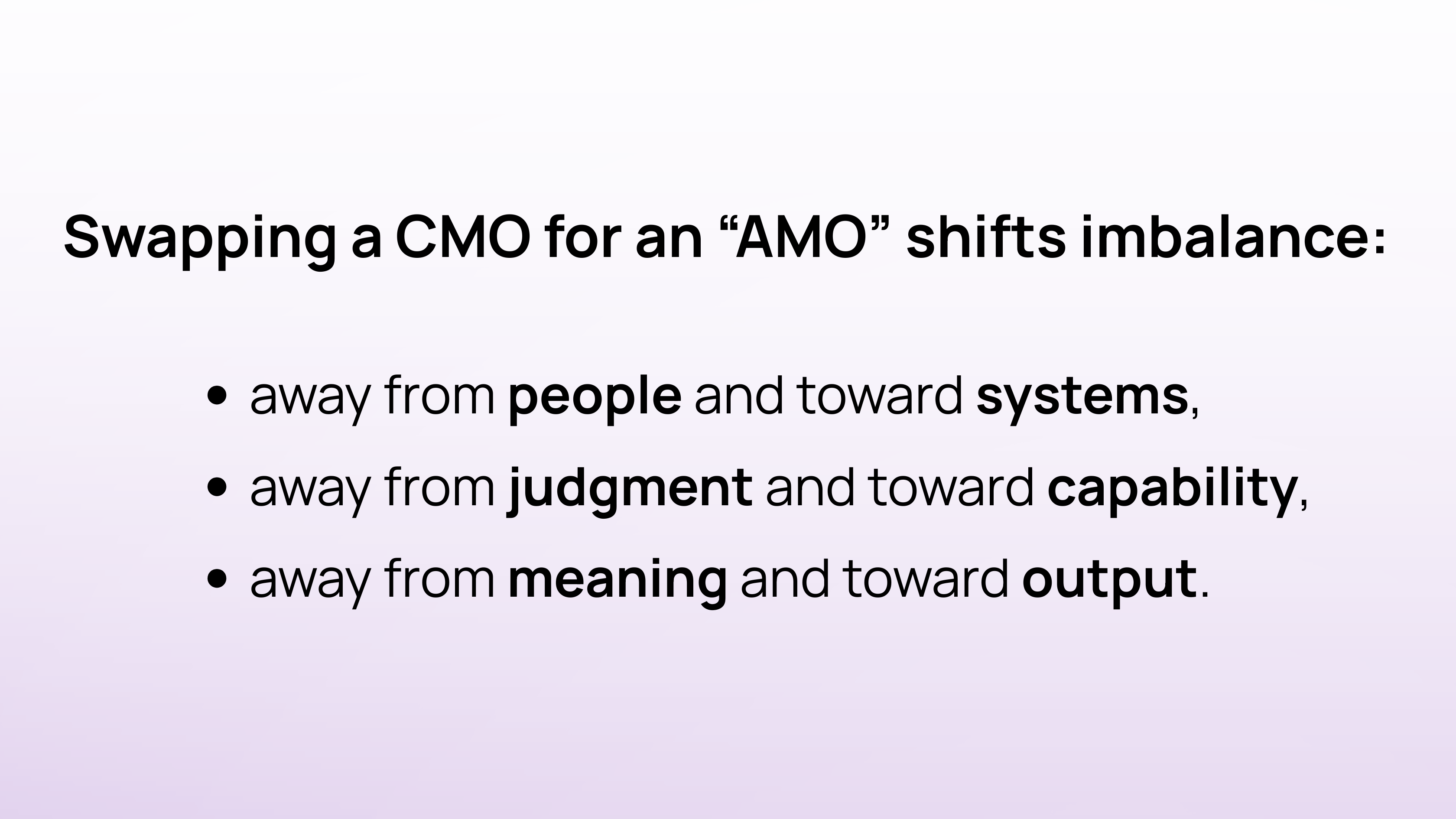
Swapping a CMO for an “AMO” simply shifts the imbalance:
away from people and toward systems,
away from judgment and toward capability,
away from meaning and toward output.
And that doesn’t get us closer to what marketing leadership has always been about: helping humans make sense of choice.
Belief cannot be automated.

Where AI actually creates value (and where it doesn’t)
There’s a framework from Bain that’s helped me put language to what’s been bothering me about these conversations. It’s called the B2B Elements of Value, and it maps how buyers actually experience value:
At the base are table stakes: meeting fundamental specifications, acceptable price, regulatory compliance.
Then come functional and operational layers: quality, integration, reliability, scalability.
Above that sits ease of doing business: time savings, reduced effort, responsiveness.
In my experience, ‘ease of doing business’ is where most B2B companies compete. It’s legible, rational, and defensible. It fits neatly into a slide. It’s also the most obvious form of value.
Higher up the pyramid, though, sit personal and inspirational value: reduced anxiety, confidence, reputational assurance, and a clearer sense of direction. This part is usually only accessible to the companies who invest in deeply understanding their customers. This is the work of the Product Marketer.
AI is exceptionally good at strengthening the middle of the pyramid. It compresses time, smooths workflows, reduces effort, and helps teams move faster. That value is real, and it matters.
But it’s not the top.
Right now, AI still feels like differentiation because we’re early enough that capability itself feels novel. Walk any conference floor and you’ll see “AI-powered” everywhere.
But you and I both know that the novelty won’t last.
It reminds me of Uber in San Francisco in 2010, when ordering a car from your phone felt futuristic. Fresh. Pioneering.
Today, ride sharing is table stakes. The apps are interchangeable and loyalty is thin.
I think that’s the arc AI is on.

Building the AI floor (what table stakes actually look like)
To be clear, none of this is an argument for ignoring AI. Quite the opposite.
Most strong marketing leaders I know are already building systems around it – using AI to remove friction, compress effort, and create more space for thinking.
Dave Gerhardt recently shared a snapshot of the AI tools most used by the Exit Five community right now. His list includes tools like:
ChatGPT and custom GPTs for research, outlining, campaign naming, and internal playbooks
Claude for long-form documents and content analysis
Canva Magic Studio for fast, designer-level visuals
Descript for editing video like a doc
Perplexity as a research and competitor-tracking assistant
Surfer, Ahrefs, and Frase for SEO optimisation and recovery
Zapier and Make for automation and workflows
Clay for list building and enrichment
NotebookLM for pulling insight, messaging, and objections from your own internal data
Taken together, it’s an example of a modern marketing system in the making.
A system that helps you move faster, reduce manual work, and get from 0-1 more quickly.
And that matters. Marketing leaders should be fluent in this. But this is also where it’s important to be honest about what this actually represents.
This stack sits firmly in the middle of the value pyramid.
It improves productivity. It reduces effort. It makes teams more responsive. It helps you do more with less.
All real value, yes. But also, all increasingly expected.
It’s the floor.
So yes, build your AI tool stack. Learn the workflows. Use these tools to amplify what you’re already good at, rather than trying to become someone you’re not.
Just don’t anchor your leadership identity, or your company’s differentiation, purely in capability.
That ground will flatten quickly.
As AI pushes more value down the pyramid, real differentiation moves up – into the harder, human layers:
helping buyers feel confident rather than anxious and overwhelmed
helping teams align rather than optimise themselves into silos
helping people make sense of complexity rather than just move faster through it.
This is the part marketing leadership can’t afford to abandon.
Holding complexity without trying to erase it
I’m still ambitious. I care deeply about outcomes, momentum, and building things that matter.
But now more than ever, I reject any system that reduces people to inputs, output, or optimization problems to be solved.
AI will change how we work. That much is obvious. But it won’t resolve the deeper tension underneath it – the question of what kind of leaders we need, and what kind of value we actually want to create.
I don’t think the answer is choosing between humanity and ambition, or creativity and scale, or intuition and systems.
I think the work is learning how to live inside that tension, and how to hold complexity without trying to erase it.
The people who feel most out of place in moments of change are often the ones most capable of shaping what comes next.
Here’s to growth,
Alicia
Thanks for reading! Subscribe for free to receive new posts every Tuesday.
📣 How’d you find this content?
Let me know in this 4-question survey or message me on LinkedIn!
I've been wrangling with AI and marketing leadership and the ever-present urge to go fast and ship more, so this post was HUGELY timely for me. As always Alicia, a very thoughtful post.