
How Product Marketers earn trust with Product
Why proximity, responsibility, and consistency matter more than alignment


Heya, it’s Alicia. Welcome back to Customer Focus – a newsletter for GTM leaders focused on accelerating growth by putting the customer at the center of how you build and sell.
AI can speed you up. It can’t think for you.
The GTM Playbook teaches product marketers how to operate like strategic GTM owners – sharpening positioning, customer insight, and commercial judgment so your work actually moves the needle.
Ready to stop coordinating and start leading GTM strategy? This course for you.
Explore the curriculum →To get a feel for the content explore free templates and resources here!
Product Marketers – do your relationships with your Product Managers ever feel like oil mixing with water?
Because there’s a particular frustration I hear from Product Marketers again and again.
It sounds like:
“My PM never includes me.”
“I hear about decisions too late!!!”
“Product doesn’t really value marketing input.”
I’ve heard versions of this at startups, scaleups, and public companies. It’s common enough that people start to treat it like a permanent tension, and maybe, if I’m honest, a self-limiting belief. Like Product and Product Marketing are just destined to misalign.
But, I don’t buy that.
In my experience, the gap usually comes down to something more ordinary and fixable than personality or org design. Most of the time, it comes down to whether the Product Marketer is close enough to the work (customer and product) to earn real trust.
Real trust means being involved while decisions are still forming, not just when it’s time to communicate them.
What I learned at Deliveroo
At Deliveroo, I had a really strong PM and PMM relationship (shoutout Mikayla <33).
It wasn’t “we get along fine” or “we have a weekly sync.”
We were 100% accountable for the same outcomes, right down to the penny of incremental orders and contribution profit. We challenged each other. We trusted each other. And when everything with our product felt like it was breaking… we took turns having mental breakdowns! We even had a rule: we could never both be having breakdowns at the same time. That rule broke once, and it was… yikes.
Because we had honesty and psychological safety, we moved faster. We didn’t waste time performing competence or defending territory. We talked openly about what we were seeing and fixed things together.
At the same time, I watched other PMMs struggle with their assigned PMs. The complaints were familiar and understandable, but there was a pattern underneath them.
The difference had very little to do with talent, seniority, or where Product Marketing sat on the org chart.
It purely came down to proximity.
And quite literally, 🎶 being in the room where it happened. 🎶
I didn’t wait to be invited
Product Marketing was moved around the company more times than I can count – first I was hired into the Tech org, then we moved to Marketing, and finally to the B2B Commercial team.
Operationally, it didn’t really matter where I officially sat.
I made a conscious decision to embed myself into how product and engineering actually worked day to day (as much or more than I embedded into Commercial).
That meant joining standups and retrospectives. Showing up to postmortems and roadmap planning. Being physically present in rooms where decisions were made. Building relationships across the wider tech org, not just with my PM.
And yes, sometimes I had to invite myself. Repeatedly.
Not in a political or performative way, but more, in a “this affects customers, so it affects my job” way.
Over time, something shifted. Decisions would pause until my perspective was heard because people had seen me show up consistently. They trusted my intent, and they trusted that I was paying attention.
One moment that permanently raised my baseline confidence came from a Slack message I still think about. A Growth Engineer wrote:
“Before you started, I had no idea what a PMM did or why we needed one. Now, after you helped inform the product MVP with real customer feedback and launched Marketer globally, I can’t imagine not having that role on our team.”
That message still, to this day, means the world to me.
I treated myself as accountable for the customer experience we were shipping, not just the story we told afterwards. I stayed close enough to the work to bring real customer context into hard trade-offs.
As a PMM, the last thing you want to become is a late-stage baton pass. The only way to be considered when it’s time to make GTM decisions, is to already be in the room, influencing with customer evidence, and to be held accountable to the outcomes of those decisions.
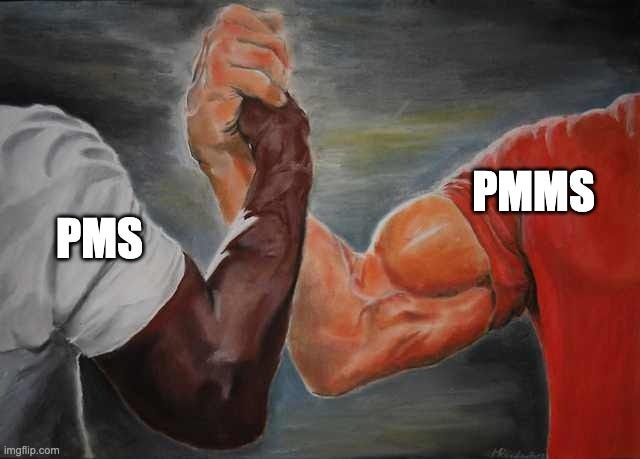
What Product leaders notice about us
To give some concrete feedback to our PMM pals, I asked a few PMs what they look for in a proactive Product Marketing partner.
I asked a VP of Product: what do you actually wish Product Marketers did better?
Their answer: closeness to the product.
“Sometimes Product Marketers get so focused on the marketing side of the role that they forget to really learn the product itself. Not just what it’s meant to do, but how it actually works.”
Where it’s strong.
Where it’s fragile.
What compromises were made.
They also mentioned that some PMMs avoid engaging with engineers. Often unintentionally, but the effect is the same. Engineers carry an enormous amount of context – edge cases, constraints, the places the product bends or breaks. When PMMs skip those relationships, they end up describing an idealised version of the product rather than the one customers actually experience.
One thing they said stuck with me:
Some Product Marketers don’t love creating internal product updates or materials because they’re not customer-facing. From Product’s perspective, internal clarity is what makes external clarity possible. When teams inside the company aren’t aligned on what’s shipping and why, customers feel it as confusion.
This feedback resonated, and mapped exactly to what I’d seen myself.
When a PMM stays close to messaging but distant from the product work, trust is harder to earn. When they embed themselves in the messy reality of building, trust tends to follow.
A senior Product Manager I know added another layer that I think matters just as much:
I rarely see gaps in Product Marketers’ skill sets explicitly. It’s more often a failure to clearly communicate the importance and impact of the work upward. When that happens, senior support fades much faster over time. The PMM role starts to get treated like a reporting function or a content function.
And once that shift happens, the work becomes reactive. You’re responding rather than shaping. You’re working from your back foot.
That, he said, is the unlock.
When Product Marketing consistently shows how its work changes outcomes – reducing risk, improving adoption, preventing confusion – leaders protect the space for it. You get brought in earlier. You get trusted with harder problems.
What this looks like in practice
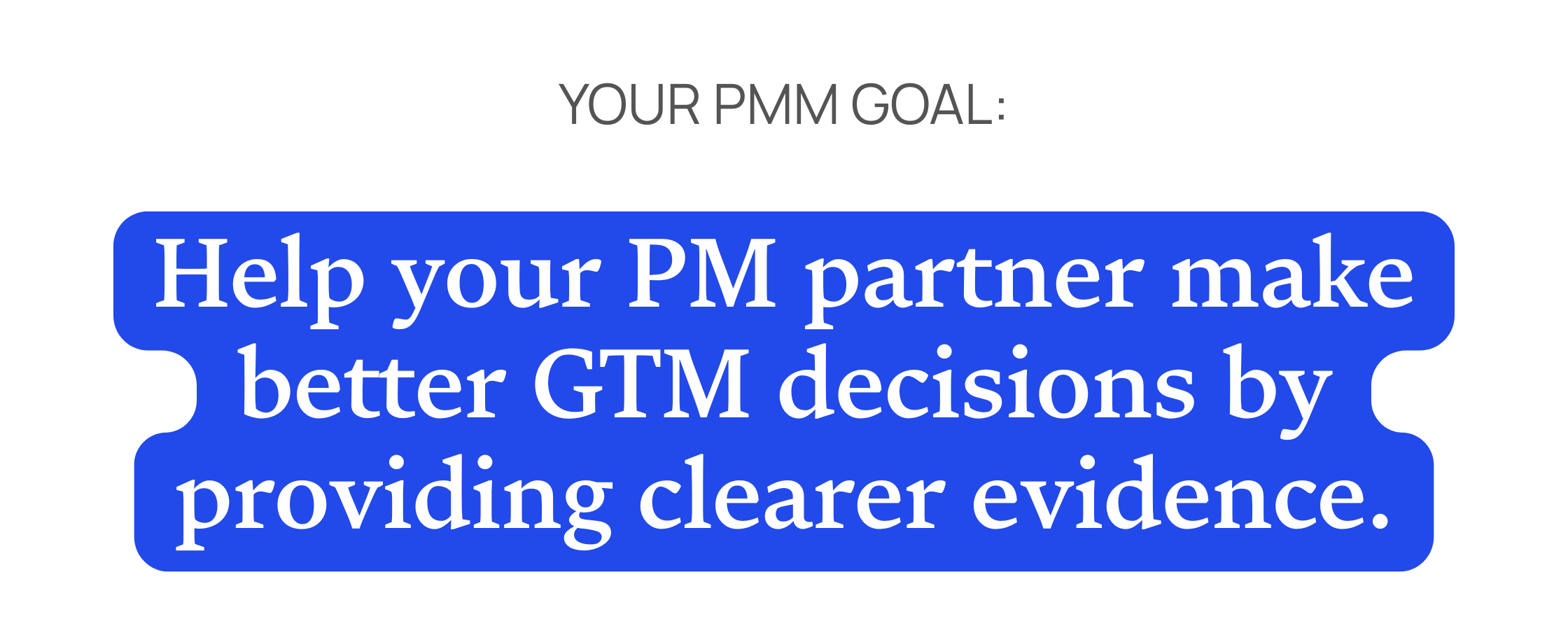
For me, this has often shown up as helping Product Managers make better decisions with clearer evidence.
In one role, when I joined the company, I spent time speaking to customers to understand who was really getting value from the product. What I found was a group of people who weren’t specialists at all. They were generalists. Their biggest source of value wasn’t advanced features – it was relief. The product helped them offload complex, stressful work and feel confident sharing decisions across their business.
At the same time, there was pressure to move upmarket. Two very different customer profiles were competing for attention.
I partnered closely with the PM and brought the evidence into the conversation. We looked at the data together. Most of the revenue was coming from the smaller, generalist segment. They loved the product, and they stayed loyal. They described its value in the same language I’d heard in interviews.
So we aligned on a simple guiding idea for the roadmap: making it easier for people to share confidence in their decisions across their organisation. That gave the PM a clear lens for trade-offs without feeling like growth was being abandoned.
Earlier in my career at Deliveroo, I had a different kind of moment.
A different PM I worked with was under pressure to prioritise a feature that promised maximum incremental revenue. On paper, it made sense. But I was running monthly office hours with commercial teams across 14 markets, and I had a strong sense it wouldn’t be adopted by the people we needed to reach.
Rather than arguing from instinct, I tried to meet her where she was.
I ran a survey across more than 100 commercial stakeholders and pulled together a simple report ranking five possible features by perceived impact. Around 60% of respondents across markets independently chose the same feature as the one most likely to drive adoption.
Seeing that evidence changed the conversation. The PM reversed the decision, built the feature the markets had rallied around, and we saw roughly 20% higher adoption in that segment. It landed with almost no marketing effort, because people already felt heard and bought in.
Just as importantly, we used the process to help teams give feedback in a way Product could actually act on. That paid dividends long after the feature shipped.
In both cases, my role wasn’t to “win.” It was to translate real-world signal into a form Product could use with confidence.
Trust is built in the unglamorous places
I know launches take up a lot of our time. But I believe that strong PM and PMM relationships aren’t built during launches.
It starts much, much earlier. Closer to the starting line of deciding what gets built in the first place, and why.
They’re built in recurring meetings. In uncomfortable postmortems. In trade-off conversations that never see the light of day.
That’s where shared language forms, and where psychological safety gets built. That’s what allows a Product Marketer to say, “I think this is wrong for the customer, and here’s why,” and be taken seriously.
Eventually, Mikayla and I weren’t just aligned. We were accountable to the same outcomes. That had very little to do with job titles and everything to do with time spent working through problems together.
When it still doesn’t work
I also want to level with you, my PMM pals, that even with the right approach, this doesn’t always succeed.
I’ve experienced first-hand how individual personalities can override good intentions.
You can do everything right and still hit limits.
That doesn’t change the core truth, though, that Product Marketers cannot outsource relationship-building to org charts or job descriptions.
Our job is to stay close to customers while staying honest about what it takes to build good products. That bridge only works when you show up consistently, early, and with humility.
The real job of Product Marketing
Being a great PMM is about being closer to the worldview of your customer – more than anyone else – and trusting your instincts about customers as people. Their pressures, their fears, the things they’re trying to get done when no one is watching.
If you want a better relationship with your PM, get closer to how decisions are made.
Get closer to the people building the product. Get closer to the trade-offs shaping the customer experience.
That’s where you’ll find real influence, and probably have a lot more fun.
Here’s to growth,
Alicia
📣 How’d you find this content? Message me on LinkedIn!